A knee pillow that stays where loose pillows won't.

Sleep, aligned.

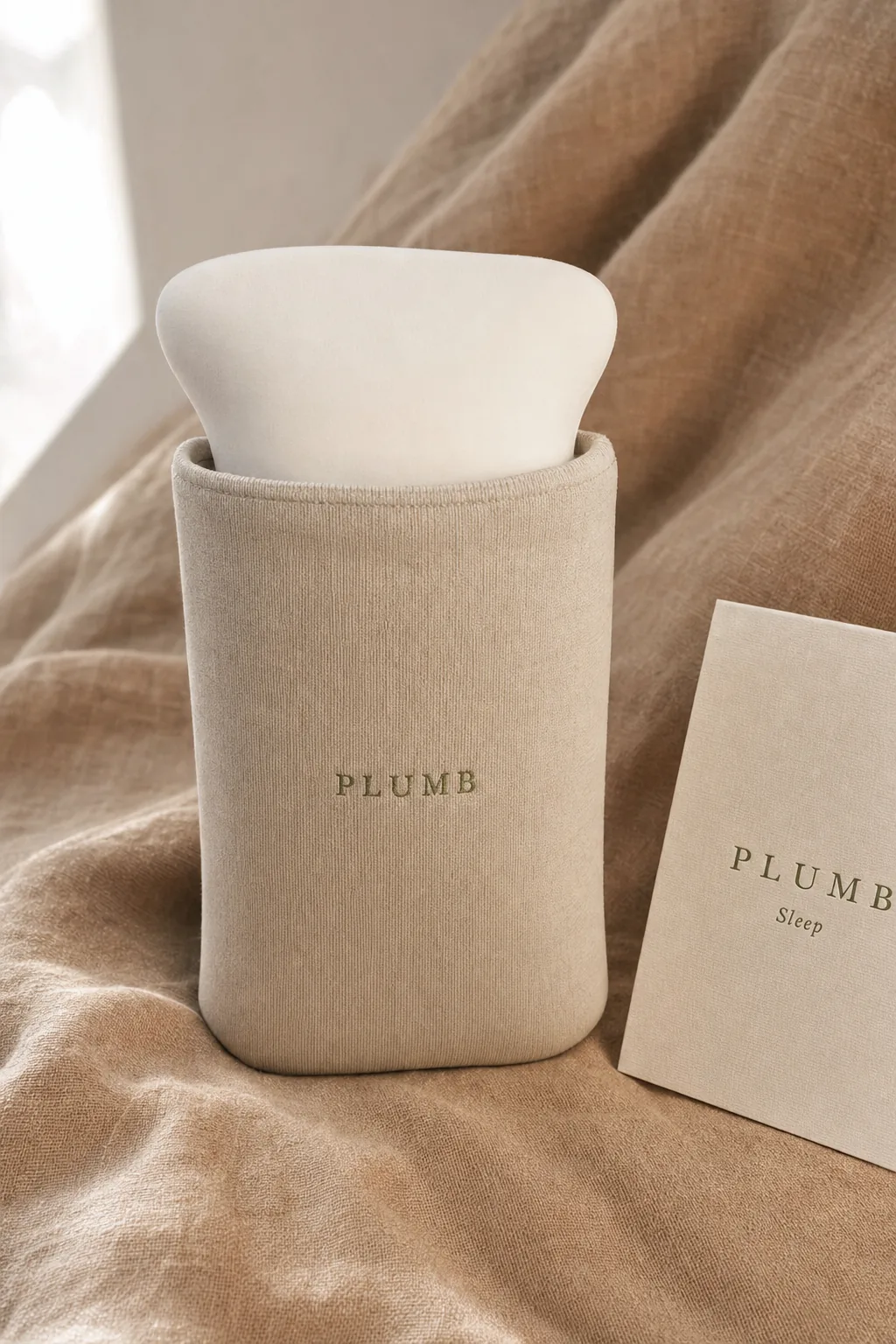
Plumb is a soft bamboo-derived viscose cuff worn on the upper thigh, with a contoured cushion mounted to the outside of the band. It seats in the gap between the thighs the way a knee pillow does — but because it's attached to the leg, it goes where you go. No 3 a.m. reaching, no kicking it across the bed. Currently pre-prototype. Sharing for feedback.

Design sketch of Plumb in side-sleep position: a single wide fabric band wraps only the upper thigh of the upper leg. A horizontally-oriented contoured cushion mounts to the band's exterior and seats in the gap between the thighs. The lower thigh is bare.
One band on the upper thigh · cushion seats in the inter-thigh gap · both legs hold it in place

The problem with loose knee pillows

Falls out.

Most side sleepers wake at least once a night to find or replace it.

Runs hot.

Foam blocks trap heat at the inner thigh, the warmest contact zone.

Wakes you up.

Repositioning interrupts sleep cycles, especially after midnight.

Feels medical.

Straps and braces invite a treatment mindset most people resist long-term.

How Plumb works

The cuff is bamboo-derived viscose knit, at least 3 inches wide, with silicone dot grippers on the inside to keep it from sliding down the leg. A contoured hourglass cushion mounts to the band's exterior. Its concave base wraps the band; its convex face contacts the opposite thigh. When you roll to your side, the cushion seats naturally in the gap between the thighs, with both legs gripping it laterally.

One band, one cushion, one leg. Designed to feel like premium sleepwear, not a medical brace.

One shape, three thicknesses

The cushion is a familiar hourglass silhouette — the same general shape side sleepers have used for decades — refined to seat in the inter-thigh gap and pair with the band.

Three Plumb cushions shown in profile from left to right: 2-inch for slim frames and soft mattresses; 4-inch (most popular), the default for most adults; 6-inch for larger frames and firm mattresses. All same hourglass shape, slate-blue Midnight colorway.
Three thicknesses · one familiar shape

Built to fit a range of bodies

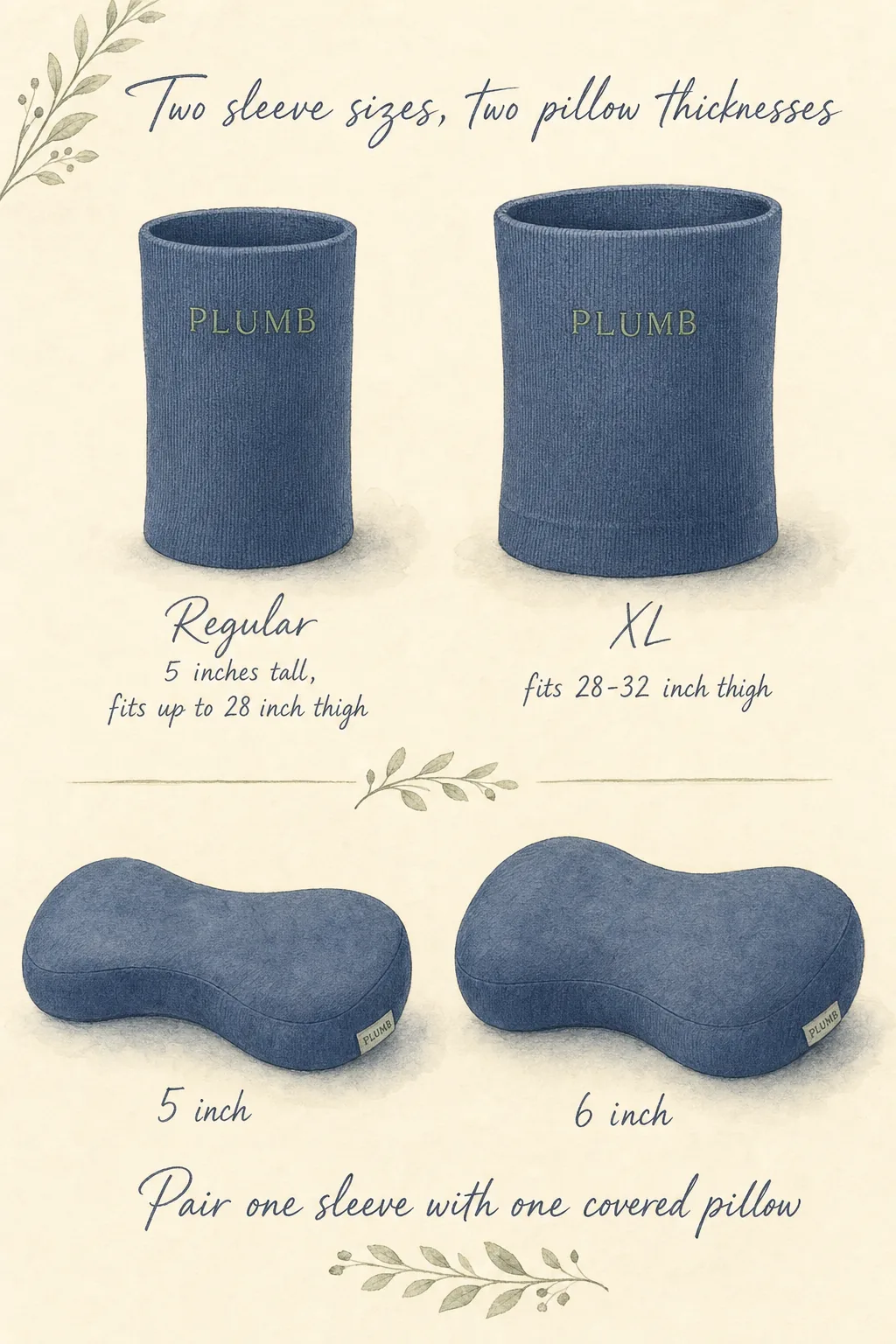
Plumb pairs two components: a soft bamboo-derived viscose cuff in Regular, Large, or XL, and a cushion in one of three thicknesses. The cuff fits the upper thigh; the cushion seats in the inter-thigh gap. We pair them at order time rather than locking a fixed combination into every box, so the product fits more side sleepers across more body sizes and life stages — including bodies that are changing.

Concept sketch showing the Plumb pairing system: three band sizes (Regular, Large, XL) shown above three cushion profiles (2-inch, 4-inch, 6-inch). Hand-drawn editorial style, slate-blue Midnight colorway.
Three band sizes · three cushion thicknesses · pair one cuff with one cushion

Two colorways, designed to pair

Plumb launches in Midnight (a soft slate-blue) and Dune (a warm terracotta-tinted oatmeal). Both with a vivid purple PLUMB wordmark embroidered on the front.

Color rendering of the Plumb band in Dune colorway: warm terracotta-tinted oatmeal bamboo-derived viscose knit with purple PLUMB embroidery. Color study, not a final product photograph.
Dune colorway · color study, not a final product photo

How Plumb differs from what's already out there

Knee pillows have been on the market for decades. Contour Legacy, Cushy Form, ComfiLife and others sell loose hourglass cushions for $25–$40. Companies like paDjamas, AliMed, and PalliPartners sell padded knee sleeves with cushions sewn inside for $35. We've used and studied all of them.

Plumb sits in between those two approaches. Loose pillows are soft and comfortable but fall out. Padded sleeves stay in place but tend to feel medical. Plumb mounts the cushion to the exterior of a soft band, so the cushion stays in position but isn't pressed against the worn leg's skin. We think that's a better trade. We'll find out when testers wear it.

What we're testing

Plumb is pre-prototype. Before we tool, source, or ship anything, we're answering four questions through a 30-night wear test:

  • Does the cushion stay in the inter-thigh gap? A band rotates around the thigh during sleep. Silicone grippers stop vertical slide, but rotation is the open question. Time-lapse video answers it.
  • Is it tolerable to wear? Sleep products fail at 2 a.m., not in a store. Tightness, heat, edge pressure, bunching — any one of them kills repeat use.
  • Does it work on both sides? Side sleepers roll. The single-band design has to work when you flip.
  • Would you reach for it on night 14? Novelty is easy. Habit is the test.

We'll publish what we learn. If the rotation test fails, we redesign or kill the idea. If it passes, the next gate is 30 strangers, not friends.

Help us pick the logo

We're between a few directions for the Plumb mark. We'd love your gut reaction. Click the one that feels most like a brand you'd want to bring home. One vote per person.

Choose your preferred logo

Honest answers

How is this different from a $35 knee pillow sleeve?

Padded sleeves put the cushion inside the band, against the inner thigh of the worn leg. Plumb mounts the cushion to the outside of the band, so the cushion sits in the inter-thigh gap rather than being squeezed against your own skin. That's the bet. Whether it actually works better is what the wear test will tell us.

Will it cut off circulation?

The band is soft knit and stretches significantly — closer to the feel of a wide compression sock than a strap. The grip comes from silicone dots, not from tightness. If a tester reports any numbness, tingling, or skin marks, we redesign. That's a hard kill criterion.

What happens when I roll over?

Honest answer: we don't know yet. The cushion stays attached to the band, so it travels with you to whichever side you roll to. The open question is whether the band rotates during the night and carries the cushion out of the inter-thigh gap. That's the single biggest thing the wear test has to answer.

Which leg do I wear it on?

The dominant leg — the one that ends up on top more often when you're on your preferred side. Most right-handed side sleepers default to right-side-down with the left leg on top.

How tight is it?

Snug enough to stay in place; loose enough that you forget you're wearing it. The band has at least three inches of width to distribute pressure across a wide area rather than concentrating it in a strap.

Is it washable?

Yes — planned for machine wash, line dry. The cushion is removable from a sleeve in the band exterior, so the foam core stays dry while the fabric washes.

Does it sleep hot?

The band is bamboo-derived viscose, which dissipates heat better than cotton or polyester. The cushion exterior is the same fabric. That said, anything on your leg adds some thermal mass — the wear test will tell us how much.

How do I pick a size?

Three band sizes — Regular, Large, XL — based on upper thigh circumference. A fit guide ships with each band. If you're between sizes, size up — the silicone grippers compensate. Cushion thickness is a separate choice based on body size and mattress firmness.

Can I use it if I already have hip or back pain?

Plumb is a sleep-positioning product designed for comfort. It is not a medical device. It is not intended to diagnose, treat, mitigate, or cure any condition. If you have hip, back, or joint pain, talk to your doctor or physical therapist about whether a between-the-knees cushion is appropriate for you.

When can I buy one?

Not yet. Pre-prototype. If the wear test passes, we'll open a waitlist and ship the first production run later in 2026.

We'd value your reaction

30 seconds. Your honest take is more useful than a polite one.

Would you be willing to try a prototype?